This isn’t as much of a review, as it is my post mortem of what turned out to be a mixed bag of an experience, having just finished the game at around 35 hours of playtime, completing 5 out of 7 (to my knowledge) possible endings.
Getting technicalities out of the way, if you’re unfamiliar with the title – The Blood of Dawnwalker is a horror, action RPG focused around a new brand of vampire antagonists called ‘vrakhiri’. Developed by Rebel Wolves (founded by ex-CD Projekt Red veterans) in Unreal Engine 5, using Metahuman framework for realistic and at times believable expressions accompanying fully voiced dialogues.
In terms of the UE5 vibecheck of the look of the game it looks stunning and obviously competent in comparison to the rest of realistic counterparts on the market. However, it does have a certain level of recognizeable pitfalls when it comes to some texture artifacting, reused Metahumans, slightly wooden faces and at times slidey movement physics. While these don’t detract much from the final product being more than a decent game, in an interview for Epic Games the CTO has pointed out that using Unreal Engine specifically lets the team focus on gamemaking rather than creating and maintaining proprietary software for their projects.
That being said, it led me to think the game would focus on making a unique chip in a monolithic RPG design that CDPR is so well known for. As the title might already lead you to believe, The Blood of Dawnwalker is not a breakthrough in game design. It’s not a failure either. It’s more of an engine check for a brand new studio to be able to navigate starting their own IP as well as proving they are able to deliver AAA experience of quality nearing or equivalent of their alma mater.
Premise and the Promise
I haven’t been as excited to play a brand new RPG since Elden Ring. And while the From Software formula is vastly different, something about the framing of a vampire story with a unique twist has enticed me to buy the game on release.
The story begins with our protagonist – Coen of Laslea – escaping the local knyaz Skender’s razing of the black plague-afflicted village with his youngest sister Lunka in his arms. They get caught in nearby ruins of a church by a band of soldiers and the aristocrat himself, who remains adamant the only solution to eradicating the deadly disease is to kill everyone infected, with no exception for children. At the very moment of an inevitable execution, Skender gets his leg ripped off at the knee and falls down to the floor while dashing clouds of smoke eviscerate the rest of his guard. It is at this point that we witness the Court of Brencis, feeding on the fallen soldiers, while Brencis himself takes Lunka away, slices his own hand and feeds her his own blood – taking away Lunka’s deadly affliction, while leaving Coen speechless. The seemingly short introduction by Brencis himself is going to ring throughout the entire playthrough – “I am life, death and everything inbetween.”
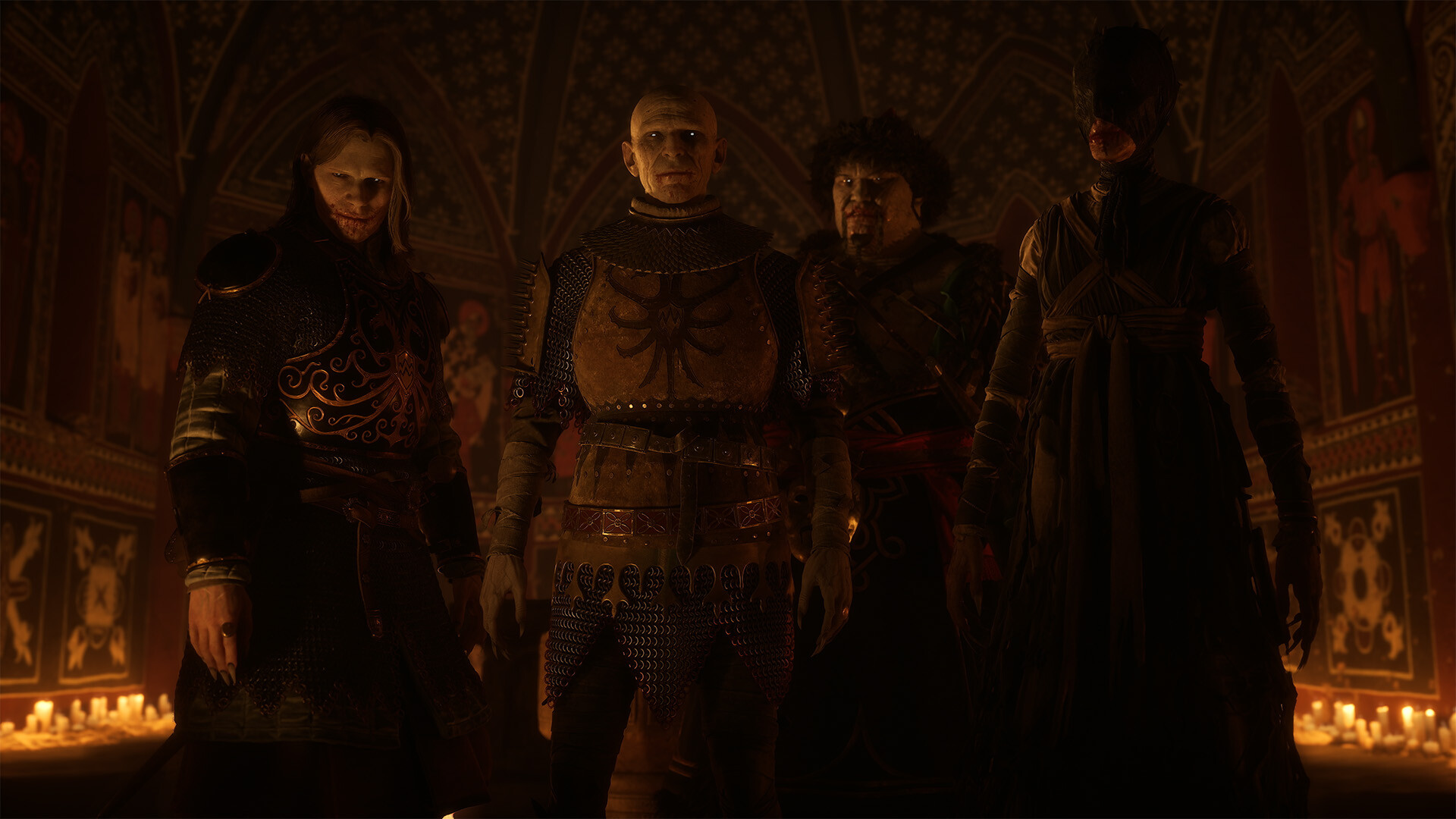
The first missions get you to lead a local revolution against Brencis’ new theocratic reign. The Blood Covenant warped the catholic belief by replacing the saints and divine iconography with vrakhiri at the centre point. The masses conducted in Laslea consisted of draining locals and then feeding them blood of the new rulers. The healing properties of vrakhiri blood let Vale Sangora overcome black plague at a cost of being drained and healed, rinse-repeat, every mass or at a whim of a scheming knyaz and his boyars – Ambrus, Bakir and Xanthe.
As you can imagine, the revolt fails and you end up face to face with the one who once a saviour, now changes you into a fresh sort of a monster – a Dawnwalker, by implanting part of himself into your heart. While vrakhiri are typically vampiric with their inability to survive the sunlight, a Dawnwalker akin to a werewolf changes forms from human to a vrakhir at night. In the course of the fight, you’re left behind while your family gets kidnapped by Brencis who has different plans for them.
The sword and the blood
With the setup out of the way, let’s begin with an immensly positive feeling I got from learning the combat system. In simple terms there are 4 elements to the combat formula:
- Physical, directional sword attacks – the only type of weapon available in the game
- Magical, fixed-target attacks – whether it’s witchcraft or vampiric abilities
- Blocking and dodging
- Passive support abilities
Very quickly you get to feel yourself in a flow of combat – anticipating directional attacks from your enemies, blocking, hitting back, often much harder than your opponents given your timings are correct. Hit, hit, parry, hit, spell, hit, parry, hit, execute. It’s brilliant in its simplicity, gory in the payoff and terrific when facing enemies with full sets of unique moves. And while I am going to defend the combat’s implementation and the fact that it did hold up through to the end, it’s the sponging balancing of enemies as a way of increasing difficulty that proved to be an annoying painpoint.
There are 3 skill trees, which by themselves are also divided into 3 distinct sections – passive perks, active abilities and ultimate abilities (which also may be passive). The separation into 3 different trees seems quite problematic when you realise that you can only ever use 2 of them at a time given the in-game time:
- Witchcraft – this set of abilities is reserved to daytime combat, although some of the passive perks pertaining to crafting seem to persist. Your own health becomes a recoverable currency for casting spells during combat. When upgraded enough the hexes transfer between enemies upon death of the cursed combatants.
- Swordmastery – these abilities persist through the day and night and pertain to physical attacks and abilities, health, stamina and blocking. Although some abilities are clearly superior to others, there are too many filler stat boosts that don’t offer anything more than % gains, while active abilities provide extra chance for proccing extra damage or immediate execution.
- Vampirism – dedicated to nighttime may unironically be the most boring part of the entire system. Although they provide option for different style of combat focusing your claws, they largely don’t provide interesting tradeoffs – rather bolster your offense with burst damage or help you heal in combat way too effectively. In fact, despite having supernatural abilities of a vrakhir, the final boss fight is in my opinion much easier when utilising Witchcraft abilities as a human.
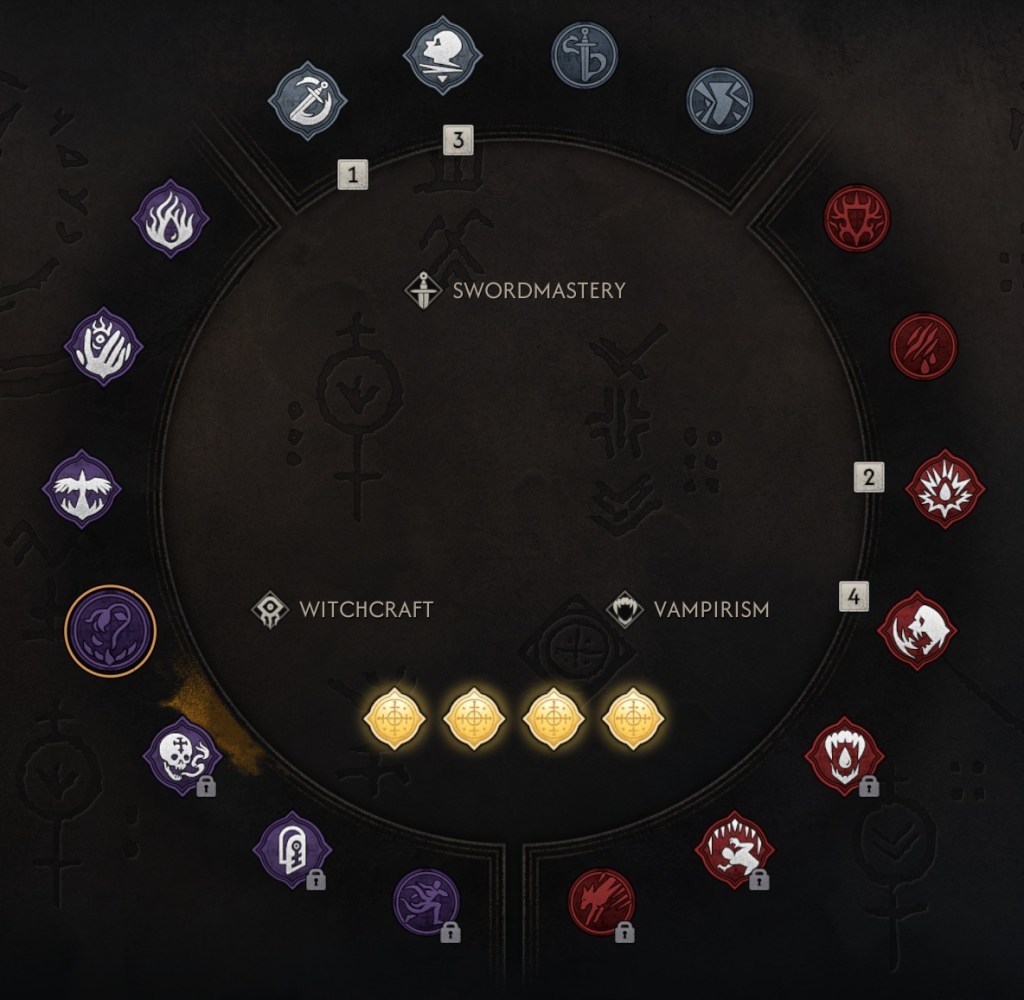
While the division may seem obvious from the lore perspective, I don’t think the system itself enriches the RPG beyond the need for typical powerspikes of certain abilities allowing you to either wear specific armor types or dealing lots of burst damage. Some of the abilities offer crowd control, but it rarely is required despite fighting off hordes of enemies towards the end-game.
Using time as currency would feel a bit more rewarding if you were to study, practice or talk with someone who can impart the knowledge to you. Standing at a waypoint and improving your character by clicking a tree, seeing the day and night go by really takes you out of the world and puts you back into your gaming chair, at home not in Vale Sangora.
Time isn’t really of the essence
Probably most notable and really, at this point dull conversation about the time mechanic in this game is where I found the most wiggle room to be found regarding the game design opportunities. In The Blood of Dawnwalker you get 30 days to prepare to face Brencis and rescue your family. Days and nights are split in 8 segments each which are used as currency for the quests and surprisingly to me also improving your abilities in the skill tree. For anyone actually having modded out the time mechanic, I believe they must have stripped potentially the only redeeming part of the game giving us reasons to pace your quests accordingly.
In actuality the system is underutilized by being extremely generous with the 30 days AND nights to save your family, givng you plenty of currency to spend on quests and abilities and messing around Vale Sangora to your hearts desire while your family is in a dungeon of a bloodsucking monster.
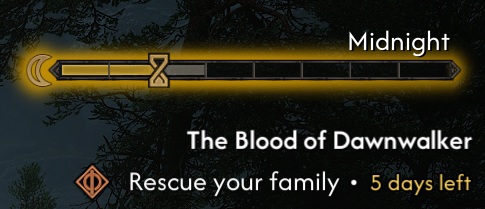
The urgency you feel at the very start and the anxiety of committing to one of the quests rather than all, quickly wears off. In fact, during my playthrough I’ve managed to lose track of amount of quests I picked up and what I needed to do at the time while collecting more and more tasks in my journal. I still did so much because I was allowed to do so – I’ve experienced what I feel is most that the game has to offer in one playthrough which feels at odds with the dev’s own desire for us to experience this game multiple times.
I have a strong feeling if we gave the player a much shorter notice for game completion, I would feel much more inclined to replay it and only follow one of the few possible approaches to the task at hand. Let me fail, let me make a real choice, that takes a toll on Coen and how his story plays out. I am aware this carries a massive risk at offending already fragile gamers these days, but this quite unique mechanic’s implementation felt a bit too half-hearted for me. Although, I don’t believe that simply reducing this time would be a fix-all solution for each conclusion to feel truly earned.
Open world trap
The decisionmaking most frequently is presented to you via dialogue options, again drawing similarities to Witcher even to the point of highlighting some of the specific outcomes. While initially it makes a lot of sense to interrogate local villagers, it soon becomes not only a narrative tool but also a chore to complete some of the repeating activities in the open world. In my opinion, those could have done with more diagetic or contextual prompts instead of dialogue option picker.
My initial experience with the game got me so engaged into the story setup that I didn’t realise in time I’m getting roped into quest collectathon/clear all map markers/scout area like a true assass- I mean dawnwalker type of experience. I’m not mad, just disappointed. That realisation only truly hit me after meeting the first of the boyars – Ambrus.
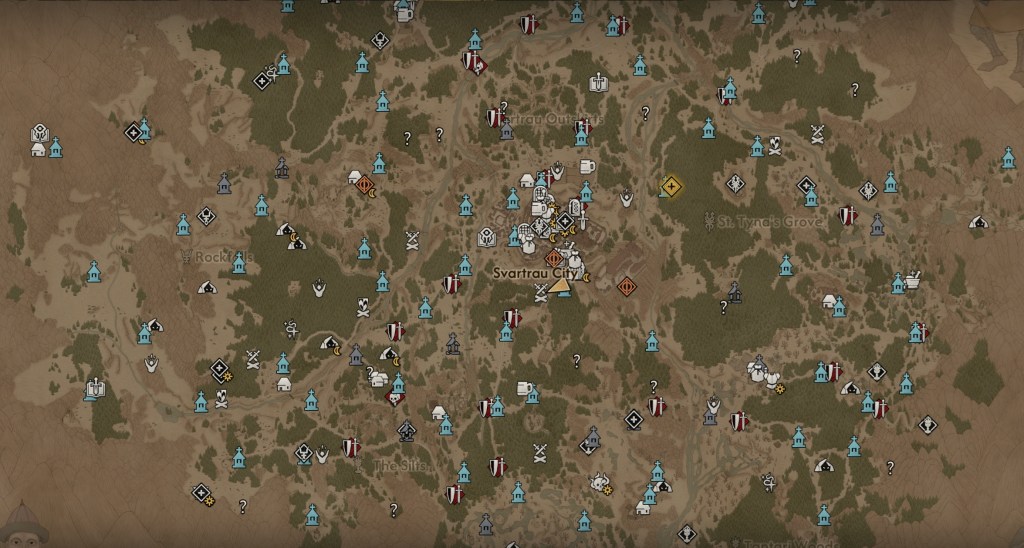
Having pissed him off enough, I get to parlay with the prince charming himself offering little to no mercy or consideration what the monster has to offer. Roleplaying as a grieving, confused and yet still driven by revenge young man, I don’t want to hear each monster’s excuse or offer which leaves both my family and countrymen in a no different vrakhiri shituation. Not only did the fight not pose much of a challenge, the backstory of each of the boyars was extremely lacking, with the final mission being the only real flavour to their entire storyline.
Maybe that’s the part that also bothered me in the experience of this weird medieval oasis – you only ever hear of the cruelty happening and only on a couple of occasions you see some of the true nature of the new rulers. Most of the time, we seem to really only hate the opportunist human soldiers that do blood draining, deliveries or look after logistics of running tight ship among the general population. You can call me a freak all you want but I really would much prefer to see the atrocities that fuel the valley into a revolt rather than read about them from various notes and occasional orders from soldier camps. The initial missions – e.g. finding the stolen banner in Laslea or breaking out the miller from a soldier camp – feel detailed, intricate yet straightforward enough that I complete them in one breath and feel real excitement all the way. The dramatic performances from the voice actors and believeable situations you’re finding out about in real time drive the sense of urgency and righteousness to your cause.
Sadly this feeling didn’t last for me long enough as between the interesting missions that engross you into the world, there are a few too many mechanics that are repetitive and eventually uninteresting in grand scheme of things. I don’t necessarily dislike the activities having a real impact on the world – causing the Court to notice you sabotaging their operations. My issue stems from the fact that I nearly cleared out the entire map and still had time and chance to witness all of the endings from a single save point at 5 days left to the fateful day of Brencis’ coronation and your family’s demise.
To the bitter end(ings?)
Now while what I’m going to say next is a fairly strong opinion, I’d encourage you to give the general gameplay of this title a look in case you do like the tight, yet very fluent combat, certainly a unique protagonist and a story that has a lot of highlights and at times great payoffs. All things considered I enjoyed the game a lot and I’m glad I have experienced it at launch with my opinion not swayed by any of the media or review coverage. So in case you are not dissuaded by my rambling about miniutia of the gameplay systems and digressions about filler activites, please buy the game because despite my complaints there is a competent action game to be experienced here.
SPOILERS AHEAD (You have been warned): There goes my final gripe with The Blood of Dawnwalker and possibly the biggest slap in the face. I should have and maybe would have expected it if I read the dev interviews and media coverage that this is only the first entry in the planned “saga”. What it means is that the endings are all nearly exactly the same with a medieval slideshow of frescos summarising your campaign’s excursions.
Every mainline ending sends you back to Laslea after the final fights and shows you the unchanging elements that setup the road to the sequel in a hard-handed, unabashed manner. You get to know there is some secret council overlooking the supernaturals’ activities, that rights the wrongs done by the wrongdoers and nearly like men in black, flashes everyone’s memory making recollection of real stories become merely legends or be completely forgotten. Your family sometimes survives completely, yet Lunka is always turned into a monster which can only be fixed by joining the service of council of Augurs who require your full commitment. You leave the valley with your little sister, with a flash forward to modern day where leather-clad Coen gets an Uber delivery of fresh blood while being attacked by seemingly returning foe.
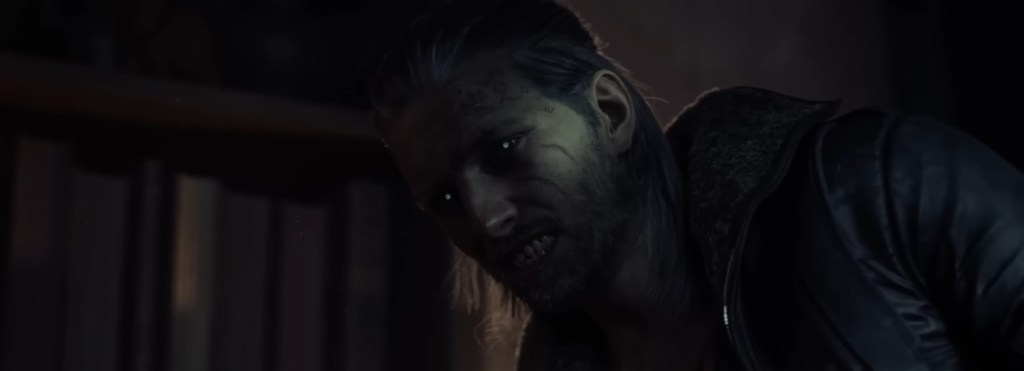
The scene itself felt cool, exciting even – setting up the mascarade-esque possibility for the sequel’s setting. I really didn’t need a happy ending, which wouldn’t feel right anyways. In fact I’m a big fan of a nuanced, convincing and real drama to the very end of any game, book or movie. However, in their totality the endings really made me feel sick. Having comitted to all of the different avenues of saving the day with the outcome always being the same – clearly not for the sake of the Greek style tragedy of inevitable failure, but a lazy device for forcing a sequel to the predetermined stencil.
Conclusions
There were multiple times over the course of my time with Coen when I stopped for a couple of minutes, completely awestruck to take in the Carpathian-inspired landscapes and traditional art backpinning the medieval setting of this story. And while I am personally familiar with little of the source material that writers have consumed at the time of production of the game, I couldn’t help but feel that the aforementined DNA risked making this version of medieval Europe a bit more derivative.
It’s my strong belief that the Vale Sangora as a fantastical location in a historical XIV century Europe provides enough mystery and nuance to the table that my only wish was for more to be revealed and explored. I am still looking forward to this universe with excitement and deep interest, maybe this time with a bit more measured expectations.


Leave a comment